






Hub-e-Aijaz: Traditional Unani Formulation for Respiratory Complaints
Introduction
Hub-e-Aijaz is a traditional medicinal formulation described in Unani literature for respiratory complaints, including cough, catarrh, the common cold, and chest discomfort. Historical accounts also attribute pain-relieving and fever-reducing properties to this preparation.
Traditional sources claim that its effects may become noticeable after the first dose and that relief may occur within three to four doses. However, these claims have not been established by reliable clinical evidence.
Ingredients of Hub-e-Aijaz
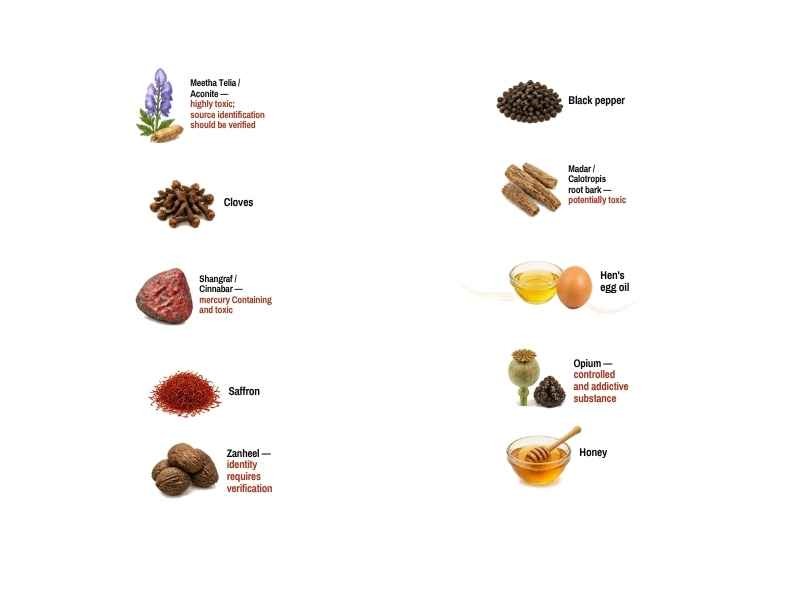
The original formulation lists the following ingredients:
Purified Meetha Telia (identified in the source as aconite) — 6 mashas (approximately 5.83 g)
Black pepper — 6 mashas (approximately 5.83 g)
Cloves — 6 mashas (approximately 5.83 g)
Madar (Calotropis) root bark — 1 tola (approximately 11.66 g)
Purified Shangraf (cinnabar) — 6 mashas (approximately 5.83 g)
Hen's egg oil — 6 mashas (approximately 5.83 g)
Saffron — 6 mashas (approximately 5.83 g)
Opium — 1 tola (approximately 11.66 g)
Zanheel — 6 mashas (approximately 5.83 g); the precise identity of this ingredient requires verification
Honey — traditionally added as needed
Traditional Preparation
Historical descriptions state that the ingredients were finely ground and mixed, with honey added to bind the mixture into small, pea-sized pills.
Safety warning: This recipe contains aconite, opium, cinnabar (a mercury-containing mineral), and Calotropis root bark. These substances can cause severe poisoning, potentially fatal heart rhythm disturbances, respiratory depression, and damage to vital organs. Purification or traditional processing does not guarantee safety. This preparation should not be made or taken as a home remedy.
Traditional Uses
Historical Unani sources describe Hub-e-Aijaz as a remedy for:
Cough and catarrh
Common cold symptoms
Chest discomfort associated with respiratory illness
Pleurisy and pneumonia
Fever
Joint pain and other types of pain
These are historical claims, not proven medical benefits. Pneumonia and pleurisy can be serious conditions that require professional medical assessment and appropriate treatment.
Historical Administration
The original text describes administering one pill with a suitable badraqa (vehicle), such as a syrup, araq (distillate), or joshanda (decoction). Because of the formulation's toxic ingredients, this historical dosing instruction should not be followed as a modern treatment recommendation.
Jawhar-e-Naushadar (Sublimated Ammonium Chloride)
Ingredients Recorded in the Historical Source
Naushadar (ammonium chloride) — 5 tolas (approximately 58.3 g)
Sabr-e-Zard (yellow aloe extract) — 5 tolas (approximately 58.3 g)
Onion juice — 10 tolas (approximately 116.6 g)
Historical Description
The source describes combining and grinding these ingredients, allowing the mixture to dry, and then extracting the jawhar (sublimate) using a traditional apparatus involving two bowls.
This description is provided for historical documentation only. Sublimation involves heating substances and may produce hazardous fumes or residues. It should not be attempted without appropriate professional chemical expertise, suitable equipment, and verified safety procedures.
Medical Safety Note
Do not use Hub-e-Aijaz to treat cough, fever, pneumonia, pleurisy, or pain. Aconite, opium, mercury-containing cinnabar, and Calotropis can be highly toxic. If someone has taken this preparation, seek urgent medical or poison-control advice, even if symptoms have not yet appeared.
Seek urgent medical attention for breathing difficulty, severe chest pain, confusion, blue lips, or a high fever accompanied by worsening respiratory symptoms.
Recent Posts

Curculigo Orchioides (Black Musli): Description, Traditional Uses, and Medicinal Properties

Mimusops elengi Linn. (Mulsari): Traditional Medicinal Uses, Properties, and Benefits

Pyrethrum Indicum (Bozidan): Traditional Medicinal Uses, Properties, and Benefits






Mesua ferrea (Nagkesar): Description, Medicinal Properties, and Traditional Uses


