






Medicinal Uses and Therapeutic Benefits of Flowers
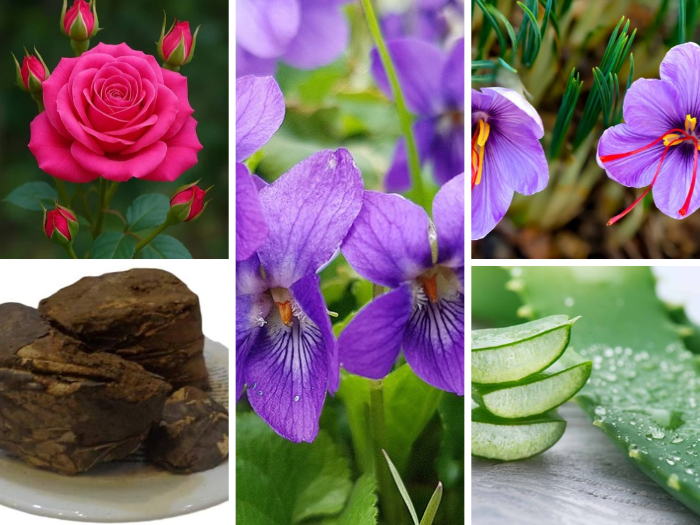
Eye Ailments
Grinding rose petals with saffron, rasont (barberry extract), and musabbar (aloe extract) into a fine paste and applying the mixture to the eyes is traditionally believed to relieve eye pain. It has also been described in traditional medicine as a remedy for conjunctivitis.
Eye Irritation and Pricking Sensation
Boil six mashas each of violet flowers (Gul-e-Banafsha) and marshmallow leaves (Barg-e-Khatmi) in water. Traditionally, the steam from this preparation was used to fumigate the eyes to relieve irritation and pricking sensations.
Fresh violet flowers can also be ground into a fine paste using a mortar and pestle. Applying this paste as a poultice around swollen eyes is traditionally recommended for minor eye complaints, particularly burning and prickling sensations.
Remedy for Earache and Ear Discharge
Prepare a decoction by boiling one tola (approximately 12 grams) of violet flowers in half a seer of water. Continue boiling until the liquid is reduced to approximately one chhatank. Strain the liquid to obtain its mucilaginous extract.
Add one chhatank of rose oil (Roghan-e-Gul) and warm the mixture slightly. Traditional texts describe this preparation as ear drops for earache and ear discharge.
Safety note: Homemade preparations should not be put into the eyes or ears. Eye and ear infections require appropriate medical assessment.
Improving the Sense of Smell
Inhaling the fragrance of fresh rose blossoms is traditionally considered beneficial for people experiencing a weakened sense of smell. It is believed to stimulate and sharpen the olfactory faculty.
Removing Unpleasant Nasal Odor
Regularly smelling fresh violet flowers and red roses is traditionally recommended for eliminating unpleasant odors from the nose. These fragrant flowers are considered beneficial in traditional medicine for this purpose.
Cardiac Tonic (Heart-Soother)
Gulkand (rose petal preserve) is traditionally used to relieve a burning sensation in the heart, while its syrup is regarded as a heart tonic.
To prepare a traditional hibiscus distillate, soak one seer of hibiscus flowers in ten seers of water for 24 hours. Distill the mixture the following day to obtain its essence (Arq-e-Gurhal).
Traditional formulations describe consuming one to three chhatanks (approximately 60–180 grams) of this distillate alongside two rattis (approximately 250 mg) of Kushta Sadaf (calcined seashell) and Marwarid (pearl), or two to four chawals of Jawahar Mohra, as a remedy for strengthening the heart and relieving palpitations.
Aksir-e-Malikhuliya (Traditional Elixir for Melancholia)
A traditional preparation for Maraq-e-Malikhuliya (melancholia) consists of ten tolas (approximately 120 grams) of hibiscus (Gurhal) distillate mixed with an equal quantity of orange or mandarin juice.
This mixture is traditionally described as an Aksir (elixir) for melancholia.
Burning Sensation During Urination
When urine becomes excessively acidic, causing a burning sensation and difficulty passing it, traditional medicine recommends soaking one tola (approximately 12 grams) of hibiscus (Gurhal) leaves in one pao (approximately 250 grams) of water overnight.
In the morning, mash and strain the mixture. Add gur (jaggery) or Sharbat-e-Bazuri (a traditional diuretic syrup) and drink it. This preparation is traditionally believed to relieve urinary burning and promote the flow of urine.
Remedy for Excessive Thirst
Consuming five to six fresh hibiscus (Gurhal) flowers is traditionally recommended for relieving intense thirst. The flowers are believed to have a refreshing and soothing effect.
Traditional Remedy for Gonorrhea
Hibiscus (Gurhal) flowers are also mentioned in traditional medicine as a remedy for gonorrhea.
According to the traditional preparation, one hibiscus flower is consumed with a small batasha (sugar drop) on the first day, followed by a drink of lassi (a yogurt-based beverage) or sugarcane juice.
On the second day, the quantity is increased to two flowers and two batashas. The dosage is gradually increased until five flowers are consumed daily. From the sixth day onward, the quantity is reduced by one flower and one batasha each day.
Medical caution: This treatment is an unverified traditional remedy. Gonorrhea is a sexually transmitted bacterial infection that requires testing and appropriate antibiotics. Delaying treatment can lead to serious complications.
Kidney Ailments
Champa flowers (Magnolia/Plumeria, depending on the plant identification) are traditionally considered beneficial for kidney complaints and gonorrhea.
A powder prepared from these flowers, or Gulkand made from them, is traditionally described as a diuretic that promotes urine production.
Migraine
Champa flowers are traditionally regarded as an effective remedy for migraines.
A paste prepared by crushing the flowers can be applied to the forehead for relief. Another traditional practice involves extracting the flower juice and instilling it into the nostrils.
These practices have not been established as effective migraine treatments. Flower extracts should not be introduced into the nose.
The relevant flowers are traditionally described as beneficial for conditions such as paralysis, facial paralysis, joint pain, and sciatica, and they are also mentioned as a remedy for convulsions.
Oil or an ointment prepared from the relevant flowers is traditionally described as beneficial for paralysis, facial paralysis, joint pain, and sciatica. It is also mentioned as a remedy for convulsions.
These conditions require medical evaluation, particularly sudden paralysis or convulsions, which may indicate a medical emergency.
Remedy for Scrofula (Cervical Lymphadenitis)
Applying a paste prepared from ground marigold leaves is traditionally recommended for Khannazeer (scrofula), a condition associated with enlarged lymph nodes, particularly in the neck. Traditional accounts claim that the preparation helps reduce the swelling and lumps.
A powder made from marigold seeds is also mentioned as a remedy. The traditional dosage is approximately nine mashas.
However, enlarged lymph nodes can have several causes, including infections, and should be medically assessed rather than treated with unverified preparations.
Blood Purifier
Champa flowers are traditionally regarded as blood purifiers. They are believed to help eliminate excessive acidity and harmful substances from the blood.
Stomach Ailments and Gastric Distress
Gulkand prepared from Mulsari (Bakul) flowers is traditionally used for several complaints, including:
Chronic headaches
Constipation
Heart palpitations
Gastric discomfort
It is considered a soothing preparation in traditional medicine.
Heaviness in the Head
Dried Mulsari flowers are traditionally used as snuff to help expel accumulated fluids from the brain and temple region. This practice is believed to relieve heaviness in the head.
Another traditional method involves smoking dried Mulsari flowers in a chilam (hookah bowl). It is traditionally recommended for dizziness, heaviness in the head, and excessive drowsiness.
Traditional Remedy for Scorpion Stings
The juice extracted from Mulsari flowers is traditionally applied to scorpion stings to relieve severe pain and its recurring waves of intensity.
Safety note: Scorpion stings can be medically serious. Seek urgent medical advice rather than relying on flower juice.
Remedy for Paralysis and Back Pain
Take fresh Sohanjana (moringa or drumstick) flowers, either raw or boiled in water. Mix them with bitter oil (such as mustard oil), salt, and mustard seeds (Rai).
Leave the mixture in the sun for three to four days to prepare the traditional formulation.
This preparation is traditionally described as beneficial for:
Paralysis
Facial paralysis (Laqwa)
Joint pain
Back pain
Loss of appetite
Pickle Made from Sohanjana Flowers and Pods
Despite their naturally sour taste, pickles prepared from Sohanjana flowers and pods are traditionally considered harmless to the nerves. They are used as a food preparation in traditional medicine.
Recent Posts

Curculigo Orchioides (Black Musli): Description, Traditional Uses, and Medicinal Properties

Mimusops elengi Linn. (Mulsari): Traditional Medicinal Uses, Properties, and Benefits

Pyrethrum Indicum (Bozidan): Traditional Medicinal Uses, Properties, and Benefits






Mesua ferrea (Nagkesar): Description, Medicinal Properties, and Traditional Uses


