






Myrobalans (Terminalia chebula): Botanical Description, Types, Properties, and Traditional Medicinal Uses
Introduction
Myrobalan, scientifically known as Terminalia chebula, is a medicinal tree widely valued in traditional Ayurvedic and Unani medicine. Its fruit, commonly known as Harad or Halila, has been used for centuries in traditional herbal preparations. The plant is particularly well known for its traditional applications in supporting brain function, digestive health, and eye care.
The tree grows in various regions of the Indian subcontinent, including parts of India and Pakistan. Its fruits occur in different shapes, sizes, and stages of maturity, resulting in several varieties recognized in traditional medicinal literature.
Botanical Description and Natural Habitat
The myrobalan tree generally reaches a medium height, although some specimens can grow up to 100 feet. It is distributed across much of India, particularly in the northern regions. Its natural range extends from Kumaon to Bengal, Assam, Burma, and Madras, including Coimbatore and the eastern parts of the Western Ghats.
It is also found in the Godavari basin, Gujarat, the Western Ghats near Bombay, the Konkan and Malabar coasts, the Vindhya mountain range, and various areas along the lower Himalayan foothills. In Pakistan, the tree grows in certain parts of Punjab.
The tree is not particularly long-lived. After growing for a certain period, it gradually dries out and eventually falls. It is also cultivated in gardens in some regions.
Leaves
The leaves of Terminalia chebula are slightly broader than those of Jamun (black plum) or Adusa (Malabar nut). They are generally four to eight inches long, oval-shaped, flexible, and greenish-white in appearance.
Although the leaves may feel slightly rough to the touch, they do not grow densely along the branches. During spring, the old leaves fall and are replaced by new ones, which initially appear yellowish-white and produce a distinctive characteristic smell.
Flowers
The flowers of the myrobalan tree are white or pale yellow. They are relatively simple in appearance and contribute to the development of its medicinally valued fruits.
Fruit
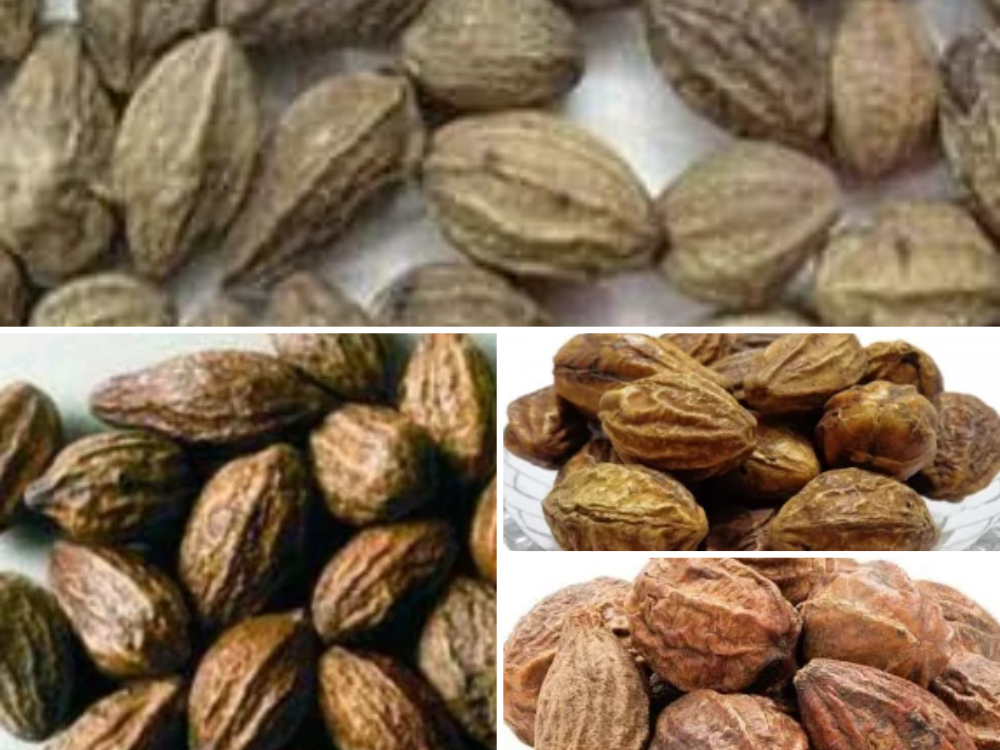
The fruit of myrobalan varies considerably in shape and size. Some varieties are elongated, while others are smaller and oval-shaped. As the fruit dries, its outer skin becomes wrinkled and develops five prominent ridges.
The fruit often falls from the tree before reaching full maturity. These small, immature fruits turn black after drying and are traditionally known as Halila Siyah (Black Myrobalan). Premature fruit drop may also occur when the fruit is approaching maturity.
However, fruits that remain on the tree until they are fully ripe are generally considered superior in quality.
Freshness is an important indicator of good-quality myrobalan. A smooth, heavy fruit tends to sink when placed in water. Nevertheless, immature fruits are traditionally considered less beneficial than properly matured ones.
The tree generally sheds its leaves around February and March, temporarily appearing bare. New leaves emerge during the rainy season, which is also considered a suitable period for planting.
Varieties of Myrobalan
According to Ayurvedic literature, myrobalan is classified into seven varieties based on differences in shape, size, colour, and internal structure.
Seven Ayurvedic Varieties
1. Dajiya: A round variety of Harad resembling a barley grain.
2. Rohitarnya (Rohini): A standard round variety of myrobalan.
3. Potna: A relatively round variety containing a small stone and very little pulp.
4. Amrita: A variety characterized by a small stone and abundant pulp.
5. Jivanti: A golden-yellow variety.
6. Chaitki: A variety distinguished by three prominent lines on its surface.
Varieties Described in Unani Medicine
Unani medicinal literature traditionally identifies four principal varieties of myrobalan:
Halila Zard (Yellow Myrobalan): A large variety of Harad.
Halila Siyah (Black Myrobalan): A dark-coloured variety.
Halila Kabuli (Kabul Myrobalan): A conical fruit that is thick at one end and gradually tapers towards the other.
Halila Chini (Chinese Myrobalan): A variety that, according to traditional accounts, is no longer commonly available.
Consequently, only three of these four principal varieties are described as being in regular use in the traditional account.
The author of Makhzan suggests that these different varieties are fruits of the same tree, with their differences arising from variations in maturity, size, and appearance.
Additional Traditional Classifications
Traditional Unani descriptions also distinguish myrobalan fruits according to their physical characteristics and stages of maturity.
Halila Zira: A dried, bud-shaped fruit resembling a cumin seed.
Larger Halila Zira: Similar to the smaller variety but approximately the size of a barley grain.
Halila Jawi: A somewhat larger variety, also described as being comparable in size to a barley grain.
Halila Siyah or Halila Zangi: A larger, black-coloured variety that does not contain a stone.
Halila Chini: A semi-ripe fruit with a greenish-yellow colour.
Halila Zard: A more mature, yellow-coloured fruit.
Halila Kabuli: The fully mature fruit, which develops a yellowish-red colour and a smooth surface.
These classifications demonstrate how traditional practitioners distinguished myrobalan according to its stage of development and physical properties.
Chemical Constituents
Myrobalan contains several naturally occurring chemical compounds that contribute to its characteristic properties. According to the traditional description, its principal constituents include:
Approximately 48% tannic acid.
Gallic acid.
Chebulinic acid, which can break down during boiling in water to produce tannic acid and gallic acid.
A small quantity of albumin.
Woody matter.
These constituents, particularly the tannins and phenolic compounds, are important components of the fruit's chemical composition.
Temperament in Unani Medicine
According to the traditional Unani classification, myrobalan has the following temperament:
Cold: First degree.
Dry: Second degree.
Traditional Medicinal Properties and Actions
In Unani medicine, myrobalan is traditionally attributed several medicinal properties. Its principal actions include:
Brain tonic: Traditionally used as a tonic to support brain function.
Brain cleanser: Considered beneficial for clearing excess moisture from the brain according to traditional concepts.
Moisture absorbent: Traditionally believed to absorb excessive moisture in the body.
Stomach tonic: Used in traditional preparations to support stomach function.
Intestinal tonic: Considered beneficial for maintaining digestive function.
Laxative: Traditionally described as having a laxative effect, particularly in relation to bile.
Blood purifier: Recognized in traditional medicine as a blood-purifying ingredient.
Eye tonic: Traditionally used in preparations intended to support eye health.
Astringent: When roasted, myrobalan is traditionally considered to have stronger astringent properties.
Safety and Precautions
Although Terminalia chebula has a long history of use in traditional medicine, its traditional medicinal properties should not be interpreted as established treatments for medical conditions. Its tannin content may affect digestion and the absorption of certain nutrients or medicines.
People who are pregnant or breastfeeding, taking regular medication, or living with an existing medical condition should consult a qualified healthcare professional before using concentrated myrobalan preparations. Avoid excessive consumption, and do not use it as a substitute for prescribed medical treatment.
Recent Posts

Curculigo Orchioides (Black Musli): Description, Traditional Uses, and Medicinal Properties

Mimusops elengi Linn. (Mulsari): Traditional Medicinal Uses, Properties, and Benefits

Pyrethrum Indicum (Bozidan): Traditional Medicinal Uses, Properties, and Benefits






Mesua ferrea (Nagkesar): Description, Medicinal Properties, and Traditional Uses


